
Frozen and Burst Pipes in Erie: What to Do First
How to tell a frozen pipe from a split one, thaw it without making things worse, and keep the next cold snap from doing it again.
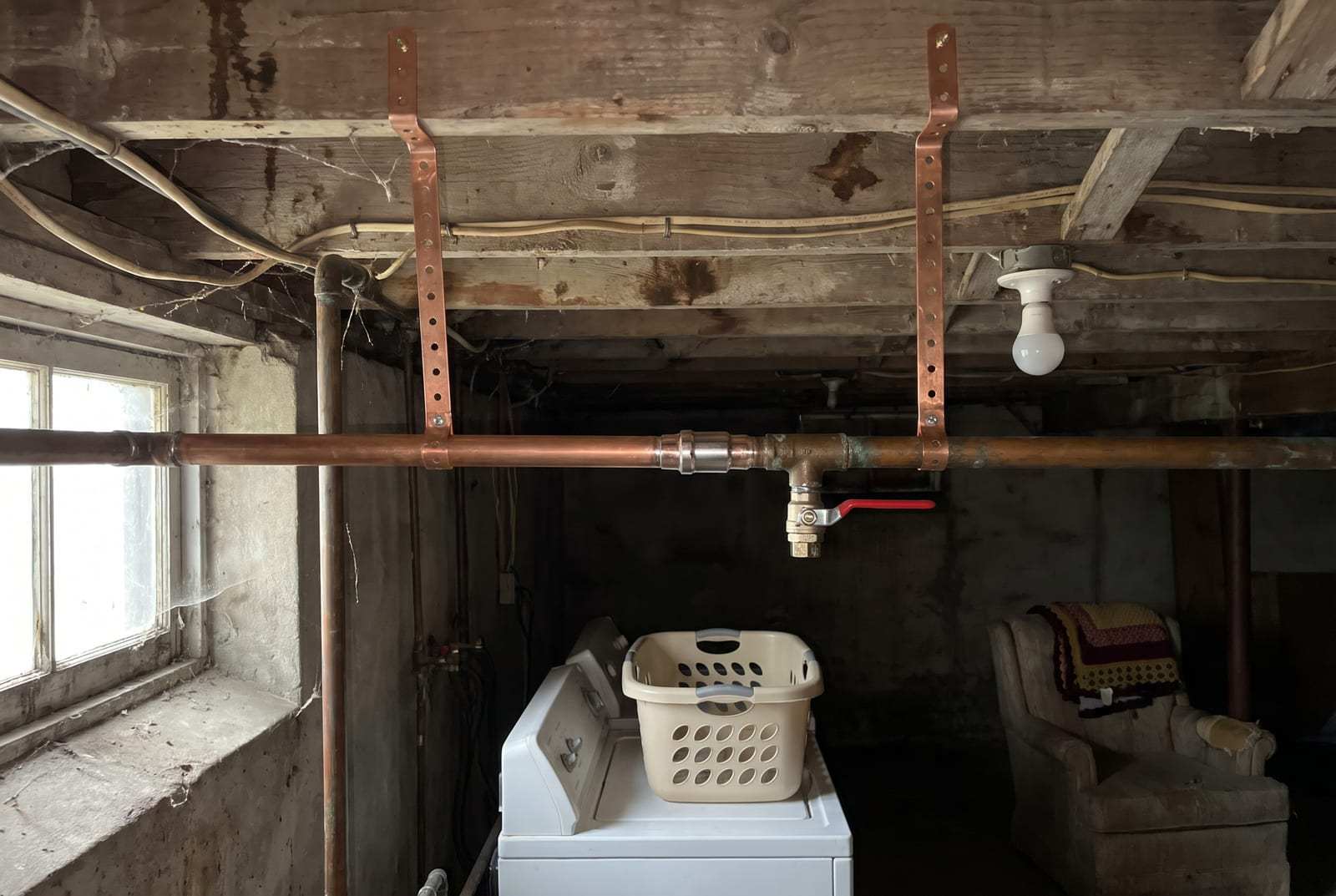
Erie winters bring long cold snaps and lake-effect storms, with wind off the lake pushing cold air into every gap in a house. Pipes freeze where that air reaches them: in outside walls, crawl spaces and garages, under sinks on exterior walls, and along the rim joist at the top of the basement wall.
A frozen pipe is not yet a leak. As the ice grows, pressure builds between it and the closed faucet, and the pipe splits, often a short distance from the ice. The split usually shows only when the ice melts, so acting before the thaw keeps the damage small.
Dry Taps, Frost, Bulges and Stains
Symptom, cause, fix
-
No water at one faucet
- Likely cause
- Ice in the line feeding it, often in an outside wall
- Fix
- Open the tap, warm the area, thaw it slowly
-
Frost on a pipe
- Likely cause
- The pipe is frozen solid at that spot
- Fix
- Open the faucet; warm from the faucet end toward the frost
-
Bulging pipe
- Likely cause
- Ice has stretched the pipe; a split is likely
- Fix
- Shut off the main before it thaws; replace the section
-
Water stain after a thaw
- Likely cause
- The pipe split while frozen and leaks inside a wall or ceiling
- Fix
- Shut off the main and call for a repair
-
Frozen outdoor hose bib
- Likely cause
- Hose left attached, or the line never drained
- Fix
- Disconnect the hose; replace a split bib with a frost-free one
-
Pipe split behind a wall
- Likely cause
- Ice pressure burst it; water is spraying or running
- Fix
- Shut off the main at once, move belongings, call
Frozen Pipe Checker
Choose one answer in each group, then press Check My Pipes.
Limiting the Damage From a Frozen or Split Pipe
- If water is leaking, shut the main valve, usually where the water line enters the basement near the meter.
- Open the affected tap, hot and cold, so melting ice has somewhere to go.
- Keep the heat on, and open cabinet doors under sinks on outside walls.
- Never use an open flame or a torch on a pipe.
- Move furniture, boxes and electronics away from any leak and from the ceiling under it.
- Note where the pipe runs, where it seems frozen and where any water showed up.
Hair Dryers, Dripping Taps and Frost-Free Bibs
Is it safe to thaw a frozen pipe myself?
Usually, if the pipe is in reach, not bulging and not leaking. Open the faucet it feeds, then warm the pipe with a hair dryer from the faucet end toward the ice, or warm the room with a space heater kept clear of walls and boxes. Never use an open flame. If the pipe bulges or has split, shut off the main first, because the leak starts as the ice melts.
Should I let faucets drip on cold nights?
For a faucet fed by a pipe in an outside wall, yes. Moving water is slower to freeze, and an open faucet relieves the pressure that splits pipes. Set a single-handle faucet in the middle so hot and cold both drip, and open the cabinet doors under the sink.
Why did a pipe freeze when the house was warm?
Because that pipe was not in the warm part of the house. Lines in exterior walls, over garages or near a gap in the rim joist sit far colder than the rooms when wind pushes outside air through the framing. Sealing the draft, insulating the pipe or rerouting it stops a repeat.
Do frost-free hose bibs still freeze?
They can. A frost-free bib closes inside the heated wall, and its long body drains when the handle is off, but a hose left attached traps water in the body. It freezes there and often splits the bib out of sight, and the leak shows the first time the faucet is used in spring.
Unheated Porches, Garages and Outside Walls
In many older Erie houses, supply lines run along outside walls, through enclosed porches and back rooms added after the house was built, or across an attached garage to a hose bib or a laundry. Those spaces get little or no heat, and they are where pipes freeze first when the wind comes off the lake. A line that freezes every winter can often be insulated, shielded from drafts or moved into heated space, which is part of pipe repair.
Winterizing Pipes and Outdoor Faucets
- Disconnect garden hoses from outdoor faucets before the first hard freeze.
- Shut off and drain outdoor lines: close the inside valve, then open the outside faucet to empty it.
- Insulate pipes in garages, crawl spaces and exterior walls, and seal drafts where pipes pass through the rim joist.
- Know where your main shutoff is, check that it turns, and keep the space in front of it clear.

When a Pipe Will Not Thaw or Has Split
Shut off the main if water is running, then call and say where the pipe is and what you have seen.