Leak Repair, Pipe Replacement and Repiping in Erie
Supply and drain lines traced and fixed, whether the trouble is one pinhole leak or a whole house of tired galvanized pipe.
Pipe trouble shows up in three ways: water where it should not be, weak flow at the taps, or water that runs rusty or cloudy. A leak can be a drip under a sink or a stain spreading across a ceiling. Low pressure can come from one clogged faucet or from a main line narrowed by rust, and brown water after the taps sit overnight points to corroding steel pipe.
The wet spot is often not under the leak, because water runs along pipes and joists before it drips. The first job is tracing it to the source, on supply and drain lines alike, and finding out what the pipe is made of. Then it is clear whether the answer is a new fitting, a new section or a new run.
Leaks, Low Pressure and Rusty Water: Causes and Fixes
Pipe problems
-
Drip at a fitting or valve
- Likely cause
- Loose nut, worn valve packing or a weak solder joint
- Fix
- Tighten or remake the joint, or replace the fitting
-
Pinhole leak in copper
- Likely cause
- Pitting from water chemistry and age
- Fix
- Replace the section with new pipe
-
Stain on a ceiling or wall
- Likely cause
- Hidden leak at a joint, drain or shower valve
- Fix
- Trace it and open only what the repair needs
-
Low pressure at every tap
- Likely cause
- Galvanized pipe closed up with rust, or a failing pressure-reducing valve
- Fix
- Gauge test, then replace the run or the valve
-
Rusty or brown water
- Likely cause
- Corroding galvanized pipe or a rusting water heater tank
- Fix
- Find which it is and replace what is rusting
-
Banging when a tap shuts off
- Likely cause
- Water hammer: quick-closing valves, loose straps, high pressure
- Fix
- Re-strap the run, add an arrestor, check pressure
Galvanized, Copper, Cast Iron and Plastic Pipe
Many older homes mix two or three materials, joined wherever someone made a repair.
| Material | Common problem with age | Repair or replacement options |
|---|---|---|
| Galvanized steel | Rusts inside until the pipe closes up; leaks at the threads | Replace the worst runs first, in copper or PEX |
| Copper | Pinhole leaks, worn joints, green corrosion at fittings | Solder or press in a section; repipe when leaks keep coming |
| Cast iron drains | Rust, cracks along the bottom, scale that narrows it | Cut out cracked sections and splice in PVC with banded couplings |
| Polybutylene (gray plastic) | Pipe and fittings turn brittle and split | Replace the system; patches rarely last |
| PEX and CPVC | Newer; CPVC can turn brittle with heat and age | The usual repiping choices, PEX for long runs in walls |
Exposed Supply Runs in Basements and Crawl Spaces

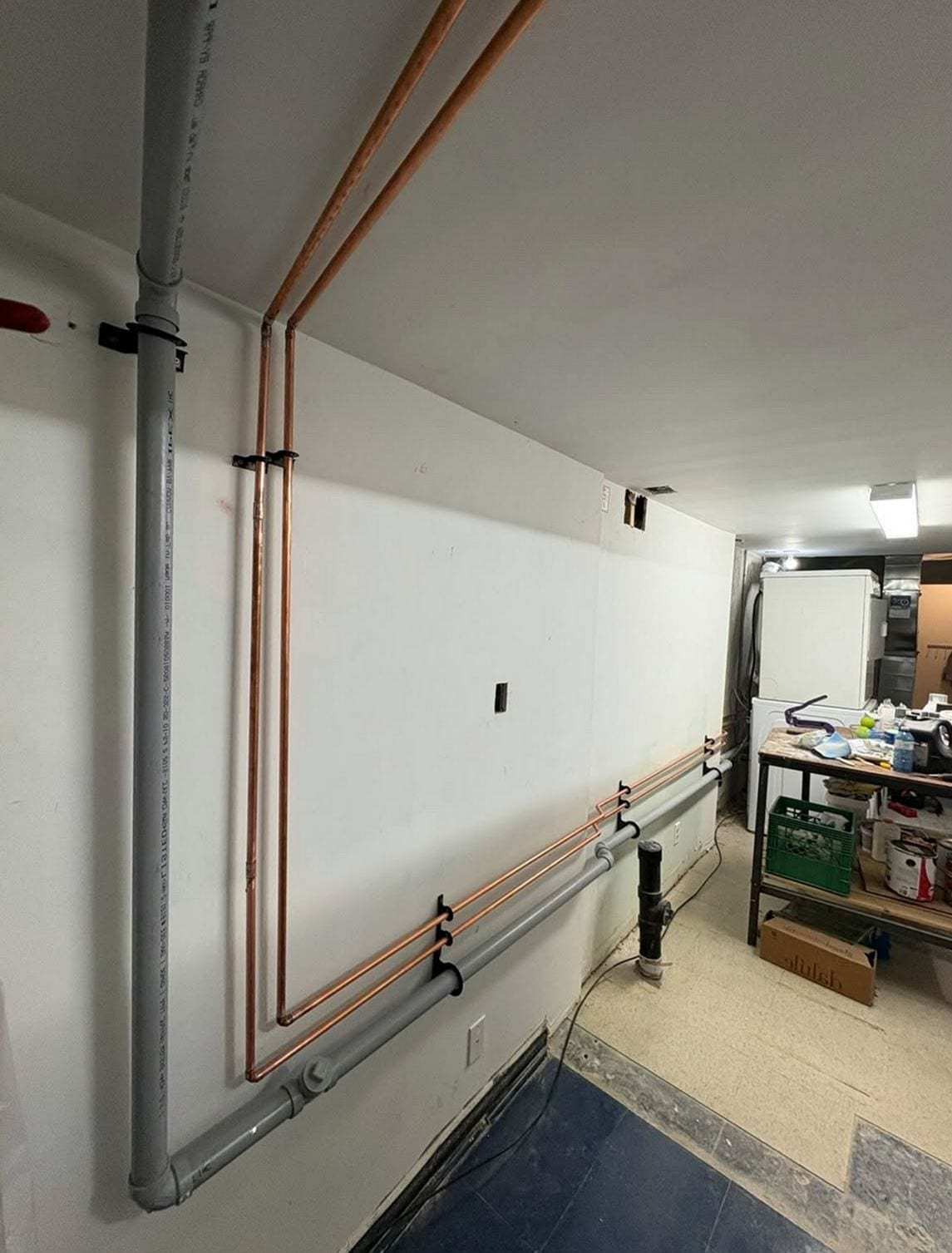
In an unfinished basement the main supply lines usually run exposed under the joists, held up with straps, with the main shutoff where the water line comes through the wall. Exposed pipe is the easiest kind to inspect and repair.
Look for green or white crust at joints, rusty drips on fittings, runs sagging where a strap let go, and valves with stiff handles. A cold pipe that sweats in summer can drip like a leak; foam insulation stops it.
Choosing Between a Spot Repair and Repiping
A spot repair fixes one leak, a few inches of pipe or one joint, when the pipe around it is sound. Section replacement swaps a longer stretch, such as the line to the kitchen. Repiping replaces the supply lines through the house, usually in PEX or copper, pulled through small openings in walls and floors.
Age tips the balance: in a galvanized or copper system decades old, the pipe beside a repair has carried the same water just as long, so mending one weak spot often brings the next to light.
We test new supply connections under pressure so a weak joint shows itself before we leave. For how a visit is arranged, see What to Expect.
When a Patch Is Enough and When to Repipe
How can I tell whether a leak needs a spot repair or a whole new run?
Look at the cut ends of the old pipe. Clean walls point to a repair; heavy rust, scale or thin copper mean the rest of the run is in the same shape.
Can part of the house be repiped and the rest left for later?
Yes. Repiping in stages is common, starting with the worst run, often the main or the kitchen and bathroom lines. Where new copper meets old galvanized pipe, a dielectric union keeps the two metals from corroding each other.
Should a repipe be done in copper or PEX?
Both last when installed well. Copper is rigid and suits exposed runs but needs more joints. PEX bends around corners, so fewer fittings end up inside walls, and it copes with a freeze better, though it must stay out of sunlight.
Will repiping fix low water pressure?
Only when the cause is galvanized pipe closed up with rust. A failing pressure-reducing valve or a clogged aerator will not change with new pipe, so it pays to measure the pressure with a gauge at more than one tap first.
Galvanized Supply Lines, Cold Walls and Shifting Ground
Many older Erie houses still have galvanized steel supply lines, often spliced to copper from earlier repairs, and some run pipes through exterior walls or unheated crawl spaces, where winter finds them first. The ground moves too: soil heaves as it freezes and settles in the thaw, and a rigid old line where it passes through the foundation can crack or work a joint loose.
A line that froze once will likely freeze again; see frozen pipes for thawing it safely and keeping it warm.
What to Check Before a Pipe Repair Visit
- Find the main shutoff and turn it gently to check that it moves; if it sticks, leave it and mention it.
- Mark damp spots and stains with tape so they can be found after they dry.
- Move boxes, rugs and stored items from beneath the leak.
- Note any change in water pressure: which taps, since when, hot or cold.

Have a Leak or Old Pipe Looked At
Say where the water shows up and what the pipes are made of, and we will reply to arrange the repair.